01Overview
WERZ produced a case study profile film for Somerset Gourmet Farm, showcasing their Sunzaun solar fence installation as a real-world example of the product's application in premium agricultural settings. The film profiles the farm and its operators while documenting the solar fence system in context.
02About the Client
Somerset Gourmet Farm is a premium California agricultural operation that partnered with Sunzaun to install a vertical solar fence system — reducing energy costs while maintaining full use of farmland for premium crop production.
03Production Breakdown
Case-study film showing Sunzaun in use at Somerset Gourmet Farm, pairing operator voice, agricultural context, and product footage into a credible real-world adoption story.
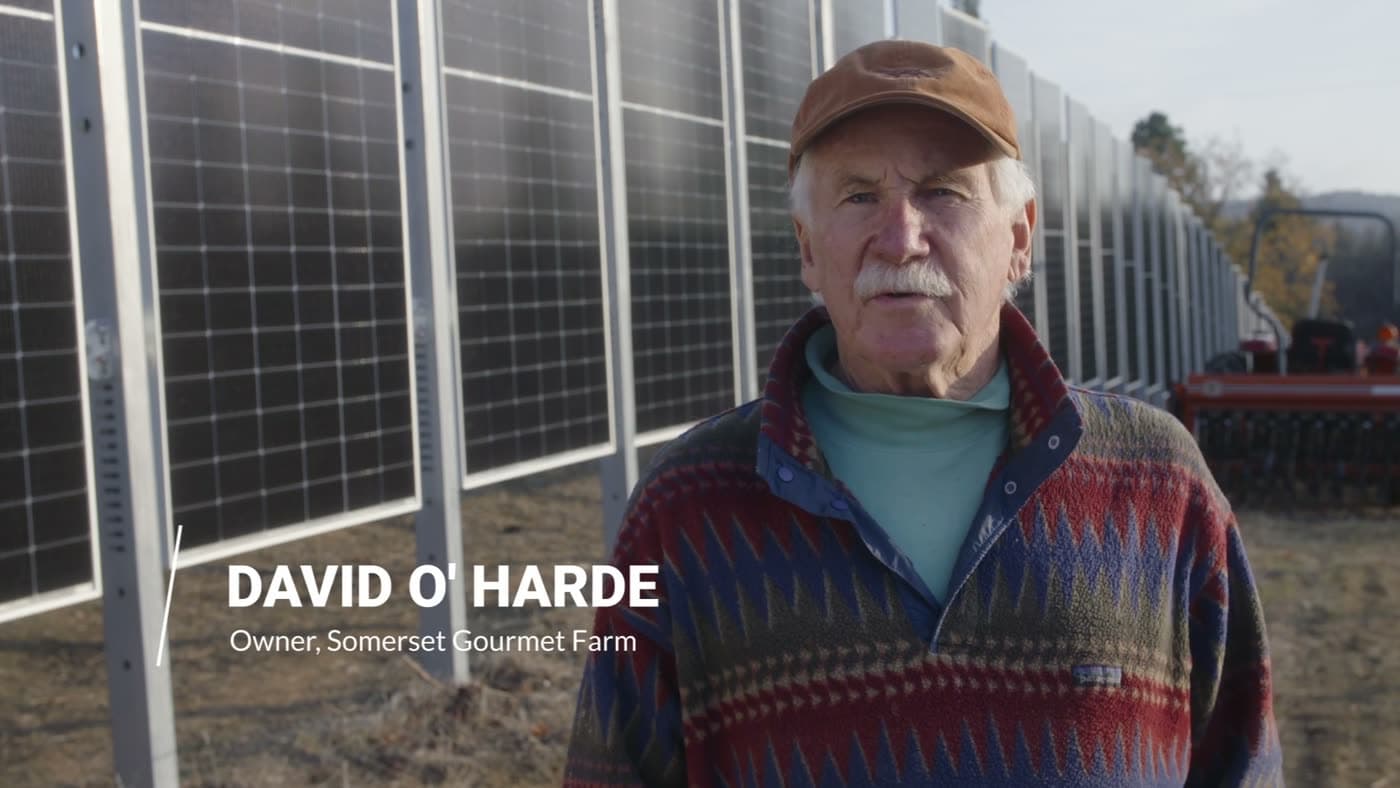
Farm-owner interview frames, vertical solar arrays along cultivated land, and product-in-context shots make the case study feel grounded and persuasive.
Spoken audio for Sunzaun's somerset gourmet farm — case study emphasizes the core message in clear, pitch-usable language. My name is David Hardy and I'm the owner-operator of Somerset Gourmet Farm. We're located in Somerset, California, which is in the foothills of the Sierras, El Dorado County.
- customer case-study film
- sales proof asset
- farm and ag-tech promo
- website trust video
- case-study interview direction
- farm-location production
- renewable-energy product coverage
- trust-building editorial
- client-story structuring
- farm interview setup
- vertical solar fence rows
- crop context
- owner or operator portrait
- working-land environment
- Shows WERZ can turn an installation into a customer-proof story with both emotion and practical value.
- Demonstrates strong agrivoltaics storytelling rooted in actual operator context.
- Useful proof for clean-tech, ag-tech, case studies, and customer testimonial campaigns.
Somerset Gourmet Farm
Featured subject associated with Sunzaun.
The film opens on Somerset's agricultural setting so the viewer sees the product inside a real operating environment.
An interview frame gives the case study a trustworthy operator perspective rather than purely brand narration.
Rows of vertical panels alongside active farm space make the dual-use promise easy to understand visually.
The ending packages product credibility, customer trust, and land-use relevance into a clear proof piece.
My name is David Hardy and I'm the owner-operator of Somerset Gourmet Farm. We're located in Somerset, California, which is in the foothills of the Sierras, El Dorado County. What we will be doing is incorporating the solar fence within our existing rows of wine grapes, utilizing more efficiently the space within our vineyard to both grow our wine grapes but also produce power for our farm.
+Full Transcript
My name is David Hardy and I'm the owner-operator of Somerset Gourmet Farm. We're located in Somerset, California, which is in the foothills of the Sierras, El Dorado County. What we will be doing is incorporating the solar fence within our existing rows of wine grapes, utilizing more efficiently the space within our vineyard to both grow our wine grapes but also produce power for our farm. It's a win-win situation so you can see where it fits in beautifully rather than a horizontal design of solar voltaics. The vertical design, bifacial, works out much better for us. Well, being that we've incorporated it within the context of our field and not isolated it out of the visibility of our local Perry Creek Road, it allows other farmers and other vineyard owners to see the possibility of incorporating it within the context of the field while utilizing the equipment and not jeopardizing the possibility of cultivation, fertilizing. It's a good fit. It's a good demonstration project for the rest of the community and the farming community to show them all the possibilities. The land we have is devoted to agriculture. On the other hand, it's multi-use. So if we are utilizing photovoltaics, producing power in addition to food, then that's it's a good fit. In the longer term, which is I'm very curious on its performance. I think it'll do very well, producing a great amount of power in the morning, midday, not so much, and then in the later afternoon. So contrast with horizontal designed systems, those systems produce much greater, they're efficient in the midday, but they fall off in the morning and they are inefficient in the afternoon. So this will give this power when we actually need it.